
"What are you doing?" he asks.
"I'm making cheese."
"Why?"
"Because I have almost two gallons of raw milk and I've already made yogurt." Yes, I did!
My pride in my industrious home-making efforts is slightly bruised by my husband's tone of voice. You know the tone I mean. The one that prosecuting attorneys use when they have a witness on the stand they don't particularly like.
He continues his diatribe, "I mean, what's the point? Can't you buy cheese?" He asks me this question in a way that indicates that he thinks I have not quite caught on to the fact that there is now human genome replication and that I am still painfully unaware that very recently, we have explored Mars.
But that's not all he has to say: "Raw milk? Is it safe?"
 |
| Yes, in fact it is safe. Read more here. The Stryk Jersey Farm has a fabulous dairy. |
My face is turned away from my husband so that he can't see my exasperated eye-roll. But even though it is still dark-thirty, sarcasm is effortless. Neurons fire best before dawn for me. I retort, "No, I'm sure it's not safe for you. Raw milk is right up there with green vegetables, sushi and those little vegan carrot cakeballs I made last weekend. Eating cheese made from raw milk would undo all that careful work you like to do with Coke, ice cream and Kit Kats."
He chortles and goes about the business of making coffee. I continue with my cheese-making. I don't care that my husband doesn't approve or even think it's safe to eat homemade cheese from raw milk. I know that this cheese will be great. It will be no ordinary cheese because I'm using no ordinary milk
 |
| Looks like butta. |
This is not a complicated cheese, it's just a simple curdled-milk cheese--a basic paneer--that I will use for cooking and sharing. It is creamy and mild and adapts well to lots of recipes. Making it from raw milk that has about two least inches of cream on the surface will make a rich cheese that spreads and melts well.
I've been making this kind of cheese for a long time. My Indian friends first showed me how to do it years ago and because it is so remarkably simple, I make it frequently. It has two ingredients: milk and acid. You can add salt and sugar to flavor the cheese, of course, but the procedure remains the same. You'll need a stove, a large pot, some cheesecloth or a thin tea towel or flour sack towel, and a sieve or strainer. A thermometer is helpful, but not necessary. Find the technique here.
 |
| My cheese and yogurt-making thermometer. |
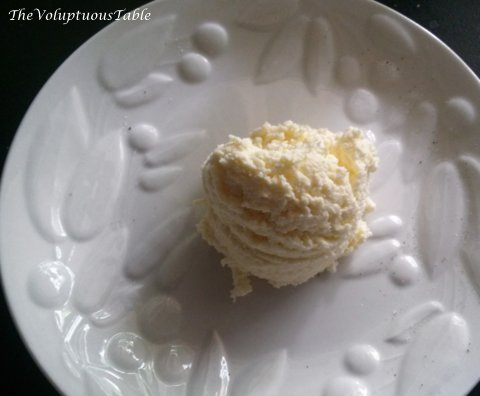
You can press as much whey out of the curds as you'd like; the less fat in the milk you use and the more you press, the firmer and less spreadable your cheese will be. I decided to drain the whey without pressing on the curds and got a creamy, ricotta-like texture.
Drizzled with garlic and herb-infused olive oil, later on, with a little balsamic vinegar and eaten with crusty bread or my personal favorite, Ines Rosales Tortas de Aceite, it's a knock-out lunch.
 |
And yes, those are Cerignola olives--so big they have the distinction of being the largest known olive. They are dense, buttery and really, really good. You can enjoy this cheese with a really lovely glass of Sancerre to pick up the olive notes, or a glass of floral, limey Albarino. Either way, you can't go wrong.
May your tastebuds dance!

